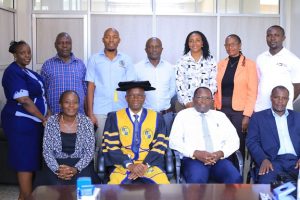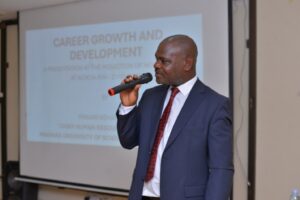

The Faculty of Business and Management Sciences at Mbarara University of Science and Technology has officially transitioned leadership, with the outgoing Dean, Dr. Fredrick Nsambu Kijjambu, handing over the mantle to his successor. The ceremony, held on 27th February 2026, marked the conclusion of a decade-long tenure characterized by institutional growth and the beginning of a new administrative chapter for the Faculty.
In a handover report presented to the University leadership, faculty and staff, Dr. Kijjambu, now conferred with the title of Dean Emeritus, outlined the key milestones achieved between 5th July 2017 and 27th February 2026. During his tenure, the Faculty navigated significant academic and administrative challenges, successfully expanding its academic footprint through the development of diverse undergraduate and postgraduate programs, including the Bachelor of Science in Accounting and Finance, and the PhD in Business Management.
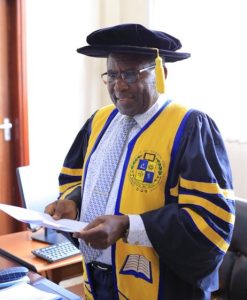
Dr. Kijjambu highlighted the Faculty’s resilience in maintaining the Bachelor of Science in Economics program despite external pressures, as well as the establishment of vital international and national collaborations with institutions such as the Institute of Banking and Financial Services and the University of Applied Sciences in Meiji, Poland.
“This handover report is prepared to enable a seamless transition of responsibilities in the leadership of the Department of Business and Management Sciences,” Dr. Kijjambu stated. “It highlights key successes, challenges, and critical issues that may require the attention of the incoming Dean and the new faculty board to ensure the effective functioning of the Faculty and the University at large.”




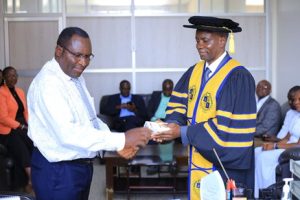
A Strategic Vision for the Future
In his acceptance speech, the incoming Dean expressed gratitude for the trust placed in him by the academic staff and the University Council. He underscored that his administration would be defined by an open-door policy, teamwork, and a renewed focus on aligning academic output with industrial needs.
The incoming Dean announced immediate plans to expand the Faculty’s structure from four to five departments, with the inclusion of the Department of Governance and Planning from the Faculty of Interdisciplinary Studies. He emphasized that the era of theoretical instruction must shift toward practical, market-ready skills.
“We are not going to be purely theoretical; we are going to be practical,” the incoming Dean remarked. “We need to think about transforming business ideas into products and services. In the near future, we will have products that show our commitment to innovation, supported by our Center for Innovation and Technology Transfer.”
Strengthening Research and Staff Welfare

Addressing the academic staff, the new Dean stressed the imperative of research and publications, stating, “If you do not publish, you perish.” He pledged to foster a culture of mentorship where senior academics support junior staff in attaining their PhDs and participating in collaborative research.
He further committed to addressing staff welfare, noting that he had previously advocated for the improvement of supervision and examination allowances. He assured the congregation that his administration would continue to push for the absorption of part-time staff who have been instrumental in the Faculty’s growth, provided they meet the requisite academic and administrative standards.
Leadership as Influence

Drawing from the mentorship he received under the outgoing Dean, the new leader emphasized that his administration would rely on “influence rather than authority.” He invited staff to be candid in their feedback, urging them to point out “leadership blind spots” to ensure that the Faculty remains on a trajectory of growth.
“I am going to be a leader that will listen, that will learn from you, and that will respect you,” he noted. “We are here as individuals, but we must act as a team. If we work together, we shall succeed.”
The ceremony concluded with tributes from the Head of Departments and staff, who praised and acknowledged. Dr. Fredrick Kijjambu for his parental guidance and dedicated stewardship, while expressing their readiness to support the incoming Dean Dr. John Kule in taking the Faculty of Business and Management Sciences to greater heights.



A legacy of mentorship and stewardship
The event served as a poignant tribute to the outgoing Dean Emeritus, Dr. Fredrick Kijjambu, whose decade-long tenure was recognized as a period of significant stability. Speakers from across the Faculty described his leadership not merely as administrative, but as deeply parental. He was credited with grooming a generation of academic staff, overseeing the growth of student enrollment, and navigating the Faculty through the complexities of academic policy.
“You have been more than a leader; you have been a parent,” remarked one of the Heads of Department (HODs) during the session. “You have groomed us, seen us grow, and mentored us. While you are no longer Dean, we hope and pray that your mentorship role continues, as your wisdom is still needed to help this environment prosper.”
Colleagues noted that the transition was a model of “best practices,” emphasizing the Kijjambu open door policy as a key factor in the Faculty’s current strength in built the foundation of the programs, innovations, collaborations growth and development established during the past decade.


A strategic vision for a changing academic landscape
In his acceptance speech, the incoming Dean, Dr. Kule, expressed his gratitude to the University Council and the academic staff for the trust placed in him. Acknowledging that he assumes the office during a time of significant evolution in higher education, Dr. Kule outlined a robust agenda centered on adaptability, quality, and practicality.
“I have assumed office in an era where things are evolving,” Dr. Kule stated. “We have an education system that requires constant review of our curricula. We must be prepared to strategize daily if we are to survive and thrive.”
A key highlight of the incoming Dean’s vision is the structural expansion of the Faculty. He announced that, following Council approval, the Faculty will soon integrate the Department of Governance and Planning from the Faculty of Interdisciplinary Studies, expanding the Faculty’s scope from four to five departments.

Emphasizing a shift toward practical education, Dr. Kule challenged the staff to move beyond theoretical instruction. He highlighted the urgent need to transform student business ideas into tangible products and services, noting that the University Senate is increasingly advocating for innovation that leads to employment.
“We are not going to be theoretical; we are going to be practical,” Dr. Kule asserted. “Next academic year, we plan to showcase products and services generated from student projects. We have the Center for Innovation and Technology Transfer and our business incubation clinic to support these initiatives, and we must ensure our students’ ideas are not just shelved.”
Commitment to Quality and Collaboration
The new leadership has committed to a rigorous focus on quality assurance, ensuring that all examinations and academic processes align with the latest regulatory requirements. Dr. Kule also emphasized the importance of research, warning that in the modern academic climate, “If you don’t publish, you perish.” He pledged to foster a culture of collaborative research where senior academics actively mentor junior staff to increase publication output and professional advancement.
Addressing staff welfare, Dr. Kule reiterated his commitment to ongoing advocacy for better supervision and examination allowances, as well as the absorption of part-time staff who have consistently added value to the Faculty.
Leadership as Influence
Closing the session, Dr. Kule defined his leadership philosophy as one of “influence rather than authority.” He declared that the Dean’s office would remain an open-door space, encouraging staff to be candid in their feedback and to help him identify “leadership blind spots.”
“I am going to be a leader that will listen, that will learn from you, and that will respect you,” he concluded. “We are here as individuals, but as a team, we have the mandate to steer this Faculty forward. If we work together, we shall succeed.”
The ceremony concluded with a renewed sense of optimism, with staff members pledging their full support to the new administration, ensuring the Faculty of Business and Management Sciences remains a leader in shaping the next generation of business professionals.