
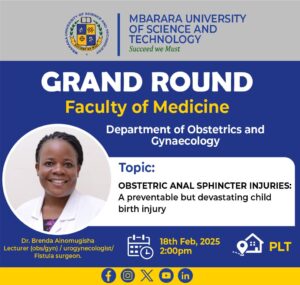
 Join us for a Grand Round titled: OBSTETRIC ANAL SPHINCTER INJURIES, A preventable but devastating childbirth injury. This session will be led by Dr. Brenda Ainomugisha, a urogynecologist/ fistula surgeon and a lecturer in the Department of Obstetrics and Gynecology at Mbarara University of Science and Technology.
Target Audience: This session is intended for medical students, Interns, midwives, medical officers, Obstetricians, Gynecologists, and healthcare professionals involved in caring for women and the entire community.
Problem/ identified gap
Perineal injury at vaginal delivery can be associated with disruption of the anal closing mechanism, and this is known as Obstetric anal sphincter injury (OASIS). This leads to crippling short and long-term adverse events; physical, psychological, emotional, social, and economic. It is associated with bleeding, perineal pain, stool and or flatus incontinence, and painful intercourse, to mention but a few. Stool incontinence, one of the worst complications, generates feelings of anger and sadness, as well as embarrassment. The sufferers avoid social gatherings and lose self-confidence, which has a proportional impact on their social interactions, sexual life, and emotional health.
Between 0.6% and 9.0% of women who deliver vaginally sustain obstetric anal sphincter injuries (OASIS). The prevalence of women with anorectal symptoms increases with the severity of the OASIS. Thirty-five to sixty percent of women with OASIS develop anal or fecal incontinence, and in women with a history of previous OASIS, the risk of occurrence is higher and varies between 5.1 and 10.7% following childbirth.
Prevention
Obstetric anal sphincter injuries may be prevented by having a skilled birth attendant at every delivery, supporting the perineum, giving a timely episiotomy, and preferably mediolateral and appropriate repair of perineal tear or episiotomy.
Diagnosis and Treatment.
OASIS is diagnosed by performing a perineal examination and a per rectal examination after delivery. Repair is performed in theatre under spinal anesthesia or saddle block:
Recommendations
All women should deliver in the hands of a skilled birth attendant. Perineal and rectal examination should be done post-decision, and appropriate repair should be done. Mothers in the postpartum clinic should also be examined for OASIS, and a delayed repair postpartum is done. We recommend delayed sexual intercourse for at least 2 months post repair, laxatives, contraception, and conception at least 2 years post repair and delivery by e, active cesarean section.
Program outline
Moderator: Dr. Brenda Ainomugisha
1. Case Presentation
2. Risk Factors
3. Diagnosis + Grading
4. Prevention
5. Surgical Repair
6. Post-operative Mgt
7. Complications & Psycho-Social Consequences
8. Occult 3rd-degree perineal tears
9. Long-term Outcomes & Recurrence
10. Q & A
11. Closing Remarks: Assoc Prof Musa Kayondo
We encourage active participation during the Q&A session following the presentations.
Meeting ID: 930 4628 2729
Passcode: 882536
See you there
