
1.0: Introduction:
Malaria is still a priority public health threat globally especially in the African region, 90% and 92% of Malaria cases and deaths respectively were a contribution from WHO-Afro countries. In 2023 Uganda was among the top 10 countries with the highest burden globally, the country ranked 3rd (contributed 4.8% to the total global cases) and 10th (contributed 2.8% to the total global deaths) – [world malaria report 2024]. Locally in 2023/24 Malaria was responsible for an estimated 33% and 22% of the total Out Patient Department (OPD) and In-Patient admissions (IPD) respectively, 11% of the inpatient deaths are due to Malaria. All Ugandans are at risk but Pregnant and children < 5years are at higher risk; they are prone to more Malaria episodes, severe forms of disease and death. Forty-four (44%) of the severe malaria cases were among children below 5 years of age, 53.7% of the Malaria deaths were under-fives and malaria was responsible for 35.7% of the all cause under 5 mortality.
1.1: Background:
World Health Organization recommended the use of the Malaria Vaccine in 2021 for Malaria endemic countries and the recommendation is to prioritize moderate to high transmission zones. So far there are two (2) recommended and prequalified Malaria Vaccines; RTSSA01 and R21-Matrix M, the indication for both is the prevention of severe forms of disease and deaths due to Plasmodium Falciparum among children. Uganda is the 19th country to introduce the vaccine and the malaria vaccine is the 14th antigen, this makes Malaria a vaccine preventable disease as is the case for others like: Tuberculosis, Poliomyelitis, Diphtheria, Whooping Cough, Pneumonia, Heamophilus Influenza Meningitis, Diarrhea, Cancer of the cervix, Rubella and Measles, tetanus, yellow fever, Hepatitis –B.
In addition, the Vaccine becomes part and parcel of the already existing Malaria Control Package that comprises of these interventions; Case management, Chemoprevention (Intermittent Preventive Treatment of Malaria in Pregnancy, Seasonal Malaria Chemoprevention-SMC), Vector Control (use of Long lasting insecticide treated nets-LLINs, Indoor Residual Spraying-IRS, Larval Source Management. Including Larviciding), surveillance monitoring and evaluation plus Socio behavior change communication. The R21 Matrix –M is the choice of vaccine that Uganda is introducing to 107 districts with moderate –high transmission districts, targeting 1,128,027 children with 3,002,100 doses in 2025.
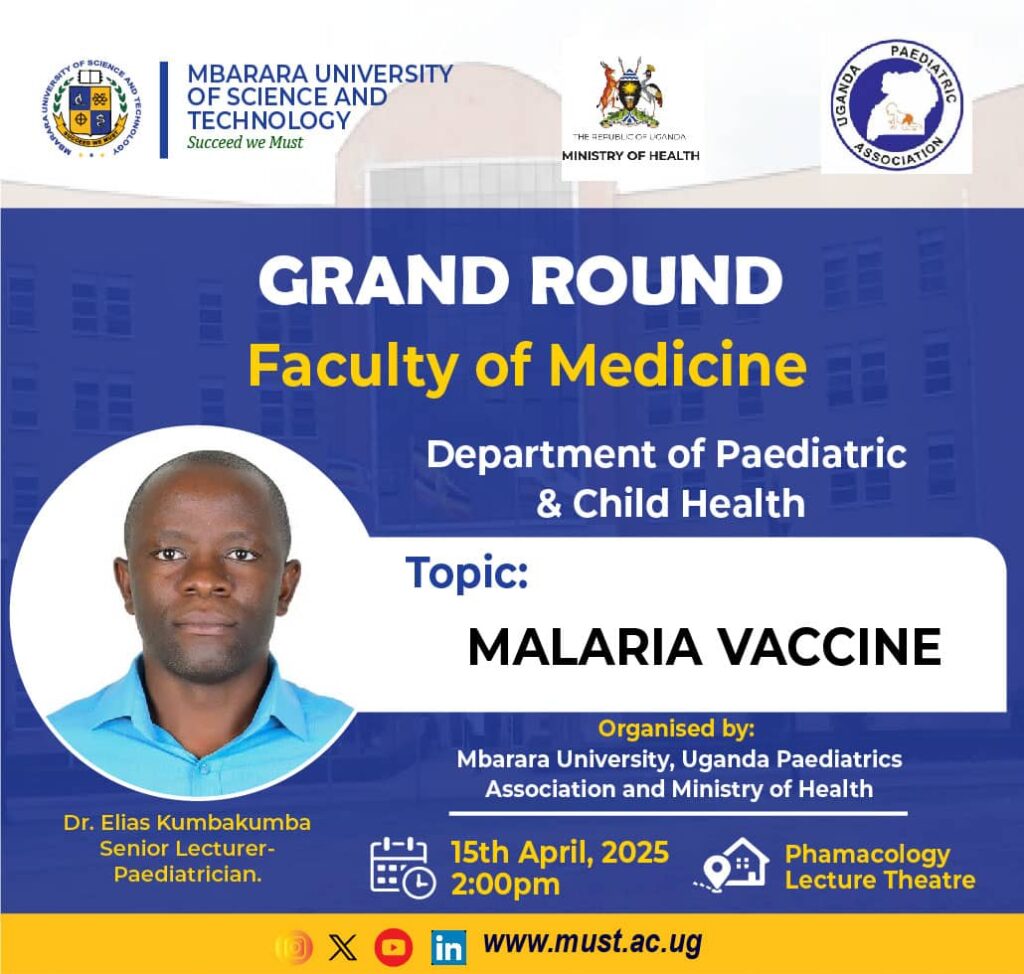
Numerous preparatory activities have been implemented; stakeholders’ engagements like- orientation of Ministry of Health staff, media experts, religious and cultural leaders, professional associations (through symposiums), media and social media engagements, training providers through didactic trainings, CMEs, grand rounds plus provision of resource materials like; training manuals, IEC materials. It is against this background that Ministry of Health in collaboration with Uganda Paediatric Association are organizing a number of grand rounds on Malaria Vaccine introduction, this being the 1st one.
1.2: Purpose:
To enhance Health-workers’ capacity to advocate for, sensitize care takers and promote appropriate utilization of the Malaria Vaccine, other Vaccines and preventive interventions through the provision of comprehensive information on the Malaria vaccine and highlight updates on other malaria interventions and Vaccines.
1.3: Objectives:
- To disseminate the Malaria Vaccine Introduction Plan and related guidelines/protocols, alongside updates on other routine immunization antigens, particularly MR2, Yellow Fever vaccine, Hepatitis B Birth Dose, Rota 3, and HPV, with academic staff, medical students, and health workers.
- To share updates on the current malaria situation and routine immunization program performance, including key indicators from UNEPI and NMED.
- To utilize subject matter experts and available evidence to address misconceptions, myths, misinformation, and misunderstandings related to the malaria vaccine and other routine vaccines.
- To jointly plan the cascaded dissemination of accurate information on the malaria vaccine and other routine immunization priorities, ensuring alignment across all levels of the health system.
1.4. Methodology
- Select team to organize the grand round and these should meet bi weekly to discuss the progress of planned activities.
- Identify guest speakers, presenters, panelists and moderators then communicate to them in writing.
- Develop and share the grand round agenda with all the panelists, speakers and guests 1 week before the grand round.
- The grand rounds will feature:
- Opening Remarks by MOH Top Management Representative:
Highlighting Uganda’s malaria burden and the importance of strengthening routine immunization, including the introduction and scale-up of key vaccines such as MR2, Yellow Fever, Hepatitis B Birth Dose, Rota 3, and HPV. - Presentation on EPI Performance and Progress on Vaccine Introductions:
Overview of national immunization program performance, with updates on the malaria vaccine introduction and progress on uptake of other priority routine vaccines. - Orientation and Training of Health Workers on Malaria Vaccine Introduction and Routine Immunization Implementation:
Focus on the malaria vaccine recommendation and introduction (clinical trials, literature review, NITAG recommendation and other new vaccines) - Discussion on Engaging Healthcare Workers in Pre-Service Training Institutions:
Exploring strategies to incorporate malaria vaccine and broader routine immunization content into pre-service curricula to enhance health worker readiness and confidence. - Dissemination of Immunization Guidelines and Protocols:
Sharing of updated guidelines and protocols for the malaria vaccine and other key routine vaccines, to ensure standardization and alignment at all levels of care.
- Opening Remarks by MOH Top Management Representative:
1.5 Key grand round outputs.
- Academic staff, students of Mbarara University, and health workers from Mbarara Regional Referral Hospital (RRH) oriented on the Malaria Vaccine Introduction Plan, as well as guidelines and updates on other key routine immunization antigens including MR2, Yellow Fever, Hepatitis B Birth Dose, Rota 3, and HPV.
- Academic staff, students of Mbarara University, and health workers from Mbarara RRH updated on the current malaria situation and the performance of UNEPI and NMED programs, with a focus on both malaria control and routine immunization.
- Academic staff, health workers, and students from pre-service training institutions and affiliated health facilities oriented on the introduction of the malaria vaccine and the importance of strengthening uptake of other routine vaccines (MR2, Yellow Fever, Hepatitis B Birth Dose, Rota 3, and HPV).
- A joint action plan developed for the cascaded dissemination of the Malaria Vaccine Introduction Plan and related guidelines, alongside communication and training strategies for enhancing awareness and uptake of other routine vaccines.
Conclusion:
By equipping future healthcare providers with knowledge and skills on the malaria vaccine and other key routine immunization antigens—such as MR2, Yellow Fever, Hepatitis B Birth Dose, Rota 3, and HPV—this grand round plays a critical role in strengthening immunization service delivery, reducing the burden of vaccine-preventable diseases, and improving child and adolescent health outcomes across Uganda.
Programme for the Malaria Vaccine Introduction and Routine Immunization Grand Round at Mbarara University of Science and Technology:
Venue: Paediatric Department
Date: Tuesday 15th April 2025
Time: 02:00 PM – 05:20 PM
| Time | Item | Person responsible | ChairPerson |
| 01:00- 02:00 PM | Arrival and registration | UPA and MOH Secretariat | UPA Coordinator Mbarara Region |
| 02: 00- 02:15 PM | Welcome remarks | Head of department Paediatrics | |
| 02:15 -02:30 PM | Opening remarks | Vice Chancellor MUST | |
| 02:30 -02:45 PM | Objectives and Key outputs | Representative – grand round organizing team | |
| 2:45– 03:00 PM | UNEPI performance updates & NIS | UNEPI – ACHS/ Program Manager | |
| 03:00 – 03:15 PM | Malaria situation and UMRESP | NMED – ACHS/ Program Manager | |
| 03:15 – 03:40 PM | Malaria Vaccine Introduction plan & Routine Immunization progress updates (Performance of other routine antigens such as particularly MR2, Yellow Fever vaccine, Hepatitis B Birth Dose, Rota 3, and HPV) | MOH representative | |
| 03:40– 04:00 PM | Key findings from malaria vaccine clinical trials &literature review | NITAG representative | |
| 04:00– 04:30 PM | Panel discussions | All Panelists | |
| 04:30– 04:45 PM | Q& A Session | All | |
| 04:45– 04:50 PM | Commitment by UPA | UPA President | |
| 04:50– 05:00 PM | Remarks by MOH | CHS-CDPC | |
| 05:00 – 05:20 PM | Closing remarks | Guest of Honor –PS MOH | |
| 05:20 PM | Departure | All |
Join Zoom Meeting https://zoom.us/j/94685533242?pwd=5QHmOZMVcbaRrsrajommvyMIIat3Eq.1
Meeting ID: 946 8553 3242
Passcode: 496096
