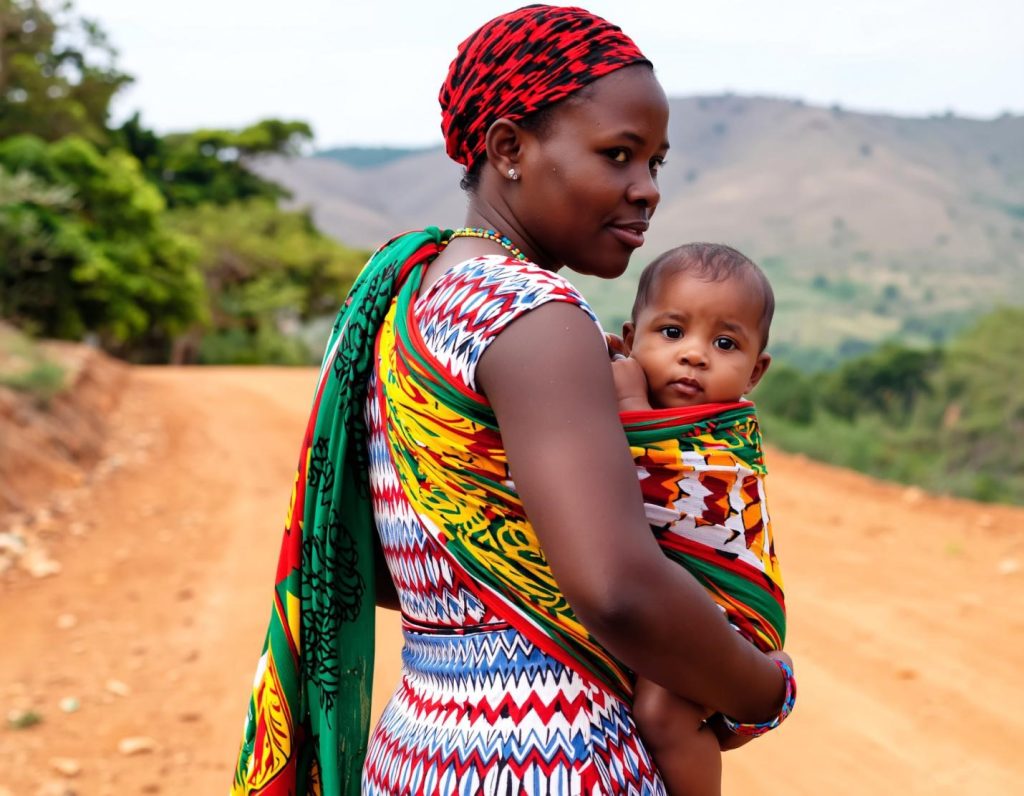
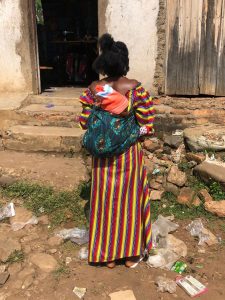
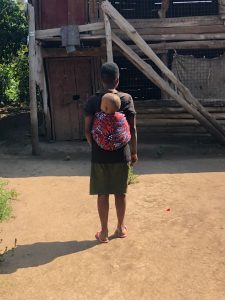
In the rolling hills of South western Uganda Kasese District, Biira adjusts the colorful cloth wrapped snugly around her waist, securing her eight-month-old daughter Ithungu against her back. The lesu, as it is known locally, has been the trusted companion of African mothers for generations a simple piece of fabric that keeps children close while hands remain free for daily tasks. What Biira does not realize is that her traditional baby wrap might just be the key to solving one of Africa’s most persistent killers.
A team of researchers from Mbarara University of science and Technology (https://www.phealed.org/team) together with University of North Carolina at Chapel Hill, (UNC) https://www.unc.edu/ conducted a remarkable discovery published in one of the prestigious New England Journal of Medicine. This has revealed something extraordinary: what women in Uganda considered an ordinary cloth to wrap a baby, turned out to be a solution to Malaria treatment. According to Prof. Edgar Mugema Mulogo a senior lecturer in the department of Community Health, MUST, and one of the PIs “ when these everyday baby wraps are treated with mosquito repellent, they slash malaria infections in young children by an astounding 65%”. He worked closely with Dr. Ross Boyce (https://www.med.unc.edu/medicine/infdis/people/Ross Boyce-boyce-md-msc/). Dr. Ross Boyce, the PI from USA, pointed out that we understood and appreciated something that had been hiding in plain sight. “We kept asking ourselves: what if the solution is not something new, but something that’s been there all along?” reflects Dr. Boyce, whose team spent months observing daily life in Ugandan communities. The study noticed that while bed nets protected children at night, mothers and their babies remained vulnerable during daylight hours when mosquitoes still bite. The answer was right there on every mother’s back.
 Brief about the study
Between June 2022 and April 2024, researchers tracked 400 mother-infant pairs in Western Uganda. Half received wraps treated with permethrin a safe insect repellent while others continued using regular cloths. The results left even seasoned researchers stunned.
Children wrapped in untreated cloths suffered 94 malaria infections. Those protected by treated wraps? Just 34 cases. The difference was so dramatic that it represented a complete shift in how malaria prevention could work.
The timing could not be more critical. Despite decades of progress with bed nets and improved treatments, malaria claimed nearly 600,000 lives in 2023 most of them children under five. Progress has stalled as mosquitoes have grown smarter, adapting their behavior to bite outside traditional protection hours
But this is not just about statistics. Behind every prevented infection is a story a mother who did not have to rush her fevering child to a clinic in the middle of the night, a family that didn’t face crushing medical bills, a child who could continue growing and learning without the setback of disease.
 Dr. Mulogo, who has spent years watching families battle malaria in his community, sees something deeper in these results. “This study shows how community-centered innovation can make a real difference,” he explains from his office at MUST. “By combining global expertise with local knowledge, we can pioneer solutions that directly address the health challenges of our people.” Click here for more information about the publication.
Message by Prof. Pauline Byakika-Kibwika, the Vice Chancellor- MUST
As the news spreads, we recognize that this work represents more than just a publication; it is a critical step toward transforming the lives of mothers and children in Uganda and beyond. We celebrate Prof. Mulogo and Dr. Ross for turning a tender, ancient practice into a powerful new weapon in global health. Their success underscores our belief that the most profound solutions often come from improving what already exists.
Prof. Mulogo and Dr. Ross , please accept my sincerest congratulations on the publication of your impactful research in the New England Journal of Medicine (NEJM). This is a monumental achievement and a true career highlight for both of you.
The MUST-UNC collaboration is precisely the model of innovation and partnership that the academic world strives for. To see your work recognized in one of the world’s most prestigious journals is a moment of profound pride for both Universities.
You have shown that by building upon the loving, daily routines of mothers like Biira , we can discover some of our most powerful weapons against ancient enemies. Thank you for your tireless dedication to making the world better.
Succeed we MUST, as the MUST motto declares – and perhaps, with innovations like these, we finally will.