
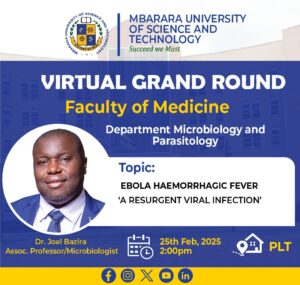
 Session Chair-Assoc. Prof. Joel Bazira
Overview:
This Grand Rounds session will focus on Ebola Haemorrhagic Fever ‘A Resurgent Viral Infection’ Ebola has primarily been reported from remote villages close to tropical rainforests in Central and West Africa. Most confirmed cases were reported from the DRC, Gabon, the Republic of the Congo, Sudan and Uganda. Ebola disease (EBOD) is a severe disease caused by orthoebolaviruses, members of the filoviridae family, which occurs in humans and other primates.
This will be led by Assoc. Professor Joel Bazira, a professor at Mbarara University of Science and Technology, Department of Microbiology and Parasitology. Assoc. Professor Joel Bazira heads the Department of Microbiology and Parasitology in the Faculty of Medicine at Mbarara of science and Technology. We will delve into the problem/identified gap, causes, Symptoms, Transmission, management approaches, and prognosis.
Target Audience:
This session is intended for Medical students, microbiologist, general practitioners, and all healthcare professionals.
Problem/ identified gap
There is an ongoing outbreak of Ebola in the country(Uganda). On the 30th January this year, the MoH in Uganda confirmed an outbreak of Ebola virus disease in the capital Kampala, caused by Sudan Ebola virus. This has become an epidemic in this region and it necessitated the continued discussion and readiness of healthcare workers and community awareness.
Causes: It is often fatal. People get infected with Ebola by touching:
• infected animals when preparing, cooking or eating them
• body fluids of an infected person such as saliva, urine, faeces or semen
• things that have the body fluids of an infected person like clothes or sheets.
The virus family Filoviridae includes 3 genera: Cuevavirus, Marburgvirus, and Ebolavirus.
Within the genus Ebolavirus, 6 species have been identified: Ebola Zaire, Bundibugyo, Ebola Sudan, Ebola Taï Forest, Ebola Reston and Ebola Bombali.
Symptoms
The symptoms of Ebola infection can be sudden and include fever, fatigue, muscle pain, headache and sore throat. These are followed by vomiting, diarrhea, rash, and internal and external bleeding. The time from when someone gets infected to having symptoms is usually from 2 to 21 days. A person with Ebola can only spread the disease once they have symptoms. People can spread Ebola for as long as their body contains the virus, even after they have died. People should speak to a health-care professional if they have:
• symptoms and have been in an area known to have Ebola, or
• been in contact with someone who may have had Ebola.
Transmission: It is thought that fruit bats of the Pteropodidae family are natural Ebola virus hosts. Ebola is introduced into the human population through close contact with the blood, secretions, organs or other bodily fluids of infected animals such as fruit bats, chimpanzees, gorillas, monkeys, forest antelope or porcupines found ill or dead or in the rainforest. Ebola then spreads through human-to-human transmission via direct contact (through broken skin or mucous membranes) with: –
• blood or body fluids of a person who is sick with or has died from Ebola; and
• objects that have been contaminated with body fluids (like blood, feces, vomit) from a person sick with Ebola or the body of a person who died from Ebola.
• Health-care workers have frequently been infected while treating patients with suspected or confirmed Ebola. This occurs through close contact with patients when infection control precautions are not strictly practiced.
• Burial ceremonies that involve direct contact with the body of the deceased can also contribute to the transmission of Ebola.
• People remain infectious as long as their blood contains the virus. After recovery, there is the possibility of sexual transmission, which can be reduced with support and information for survivors.
• Pregnant women who get acute Ebola and recover from the disease may still carry the virus in breastmilk, or in pregnancy related fluids and tissues.
Program Outline:
Moderator: Assoc. Prof. Joel Bazira
1. Opening Remarks-Session Chair- Assoc. Prof. Joel Bazira
2. CASE Presentation Dr. Timothy Lumu
3. Epidemiology and types of Ebola Viruses-Mr. Wahab Adubango
4. Pathogenesis of bleeding and other symptoms in patients with EBOV -Ms. Pauline Nalumaga
5. Epidemiology and risk factors for Transmission, Why Uganda is prone to Ebola Outbreaks -Dr. Moses Mpeirwe
6. Diagnosis of EBOV, the role of Biosafety level IV Laboratory-Dr. Kennedy Kasaza
7. Management of Ebola-treatment and role of barrier nursing in disease prevention and control- Dr. Francis Mugabi
8. Q and A, and Closing Remarks-Assoc. Prof. Joel Bazira
Session organized by Dr.TH. Kabanda
Join Zoom Meeting: https://zoom.us/j/97296443706?pwd=21c8ps7UT3jlnj2jLrNZYgQ6e26bRc.1
Meeting ID: 972 9644 3706
Passcode: 218933